
Feds’ ‘radio silence’ on fish-farm ban undermining trust, economic reconciliation, say wild salmon and aquaculture advocates

Indigenous leaders on both sides of British Columbia’s salmon farm fight are intensifying calls for Ottawa to provide answers on the future of the industry ahead of the planned 2029 phase-out of open-net pen salmon farms. But after a double delegation to Ottawa last week, both sides have gone home without any clear signals.

NDP MP Don Davies (Vancouver Kingsway, B.C.), his party’s industry critic, told The Hill Times that the government owes British Columbians, First Nations, and Canadians “crisp answers” on where it stands.
“This is a complex, important issue with critical impacts on real people on both sides of this policy, so we need crisp answers and real movement on this,” Davies said, adding that while his party’s position in support of the salmon-farming ban “has been clear” since it was first proposed in 2019, more than half a decade later, the Liberals “just keep kicking the can down the road, pleasing nobody in the meantime.”
“The science is clear, and gets stronger every passing year, that open-net pen salmon farming poses an unacceptable risk to wild salmon stocks,” Davies continued. “In our view, the government should facilitate this policy as quickly as possible toward that transition, but they're just not doing that.”
On April 29, competing delegations each held press conferences on Parliament Hill, underscoring deep divisions over whether that transition should proceed, and presenting arguments for and against the ban tailored to Prime Minister Mark Carney’s (Nepean, Ont.) new government and economic agenda.

Opposing the ban, the First Nations for Finfish Stewardship Coalition (FNFFS) is urging Ottawa to reverse course before the next salmon production cycle begins this June—two years after the policy was first announced by then-fisheries minister Diane Lebouthillier in June 2024.
Ottawa had initially committed in 2019 to phasing out open-net pen farming by 2025, but pushed that timeline back in 2024 for another five years. After missing its next self-imposed, end-of-July deadline, Innovation, Science, and Economic Development Canada (ISED) published the federal government’s draft transition plan for salmon aquaculture in B.C. on Sept. 20, 2024. The plan detailed a “basis for engagement” with coastal communities, stakeholders, and First Nations on the transition.
At the time, the government also announced that those consultations would be done by a new interdepartmental task force led by Liberal MP Ryan Turnbull (Whitby, Ont.), then-parliamentary secretary to the innovation minister, but current responsibility for that process is also unclear.
In addition to the engagement piece, the task force was intended to act as the federal government’s secretariat, with representatives from Fisheries and Oceans Canada (DFO), ISED, and several other departments, as well as the Privy Council office and National Research Bureau contributing “expertise from across [the government] in reconciliation, economic and community development, green technology, and aquaculture management,” the plan said.
Current Industry Minister Mélanie Joly’s (Ahuntsic–Cartierville, Que.) office did not respond to a request for comment by publishing deadline regarding who is now leading that task force, as Turnbull has been shuffled into a parliamentary secretary role to the minister of finance. Joly currently has two parliamentary secretaries: Karim Bardeesy (Taiaiako'n–Parkdale–High Park, Ont.) and Carlos Leitão (Marc-Aurèle-Fortin, Que.).

For the FNFFS, the lack of clarity is already affecting investment and operational decisions. Without a reversal by next June, companies will be forced to either proceed with a new production cycle that may ultimately be shut down or halt operations altogether—choices with immediate consequences for jobs and local economies, the coalition said.
“Maintaining jobs that grow Canadian food for Canadian families should be a priority for the Government of Canada,” said Dallas Smith of the Tlowitsis First Nation, a spokesperson for the coalition.

“B.C. coastal First Nations believe in conservation and having a choice to responsibly develop sustainable aquaculture economies … and salmon aquaculture is the backbone,” Smith said. “One hundred per cent of salmon farms in B.C. operate with the permission of rights-holder Nations.”
Smith said policy uncertainty has already frozen roughly $500-million in potential foreign direct investment in coastal communities, arguing that reversing the ban could unlock that capital “not in five years, but in months.”
That urgency is tied to the industry’s production cycle. Salmon farming operates on a multi-year timeline, with companies needing to make stocking and capital decisions well in advance of harvest—and long before the 2029 deadline takes effect.
Deputy Chief Councillor Isaiah Robinson of the Kitasoo Xai’xais Nation said the ban is cutting into the economy of Klemtu, a remote central coast community accessible only by boat or plane.
“Kitasoo Xai’xais Nation has a 40-year history with aquaculture … and we have confidence in the science and modern technology behind it,” Robinson said, noting the sector accounts for 51 per cent of the nation’s economy. “It just doesn’t make sense that the federal government wants us to accept the development related to tankers, pipelines, and increased natural resource development, yet it continues to block new investments in the highly regulated salmon farming sector that feeds families and employs thousands in rural B.C."

“Coastal First Nations are part of Canada, and we will continue farming salmon in a way that protects ourselves, but also Canadians,” Robinson continued, echoing Carney’s Davos speech that a nation that cannot feed itself has few options to defend itself.
The coalition also pushed back against arguments from the First Nations Wild Salmon Alliance (FNWSA), which held its own press conference earlier that day in support of the ban.
Hereditary Chief Richard “Hasheukumiss” George of the Ahousaht First Nation framed the issue as one of rights, title, and economic inclusion.
“We are the rights and title holders in our traditional territories,” George said. “We are not asking to stand outside your economic agenda—we’re asking to stand inside it … partner to partner.”
George also criticized the alliance as lacking formal rights and title, while Smith said the dispute ultimately comes down to differing interpretations of Indigenous authority.
“When the [Trans Mountain] pipeline was built, we trusted the First Nations along the path … so we’re looking for that same respect and autonomy,” Smith said, adding the coalition will continue advancing a four-pillar plan to expand Indigenous leadership in aquaculture, including research, stewardship, and ownership.
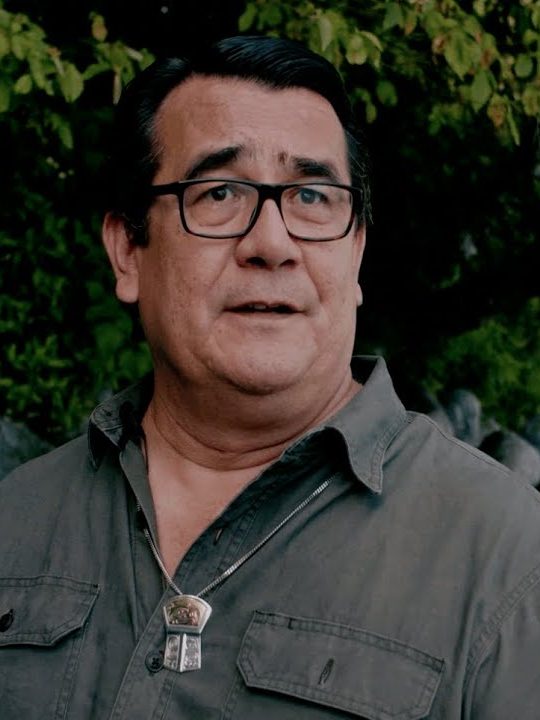
FNWSA chair Chief Bob Chamberlin of the Kwikwasut’inuxw Haxwa’mis Nation, who appeared at his delegation's presser via Zoom, said that alongside the majority of B.C. First Nations, the calls to ban open-net pens were also backed by public, peer-reviewed salmon science, despite what he views as the industry’s attempts to muddy the waters with the Canadian Science Advisory Secretariat, which advises DFO.
“What we have is 131 First Nations that support the protection of wild salmon,” he said, adding that the Crown has constitutional obligations under Sec. 35 to uphold those rights. “Economic reconciliation lies downstream from the accommodation of constitutionally protected rights.”
Despite that majority support and scientific backing, however, Chamberlin said there has been “radio silence” from both DFO and the Prime Minister’s Office.
“The silence is not helping,” he said, adding that it is undermining trust.
Heiltsuk Tribal Council Chief Councillor Marilyn Slett echoed those concerns, warning that any reversal would provoke backlash.
“If the government fails to implement the 2029 ban, there will be significant pushback from First Nations across British Columbia,” Slett said. “This ban reflects the consistent and unwavering direction from our chiefs to protect wild salmon.”
Chamberlin added that neither the PMO nor Fisheries Minister Joanne Thompson's (St. John’s East, Nfld.) office has responded to an August 2025 letter requesting a joint “province-wide” meeting to "discuss Canada’s nation-building, economic agenda in relation to the protection and advancement of wild Pacific salmon stocks and habitat in the Pacific region.”
There have also not been any updates about the release of ISED’s What We Heard Report on the transition consultations that were concluded before the last election, he said.
“We need clarity now so we can be confident that we won’t see backtracking on the ban,” Chamberlin said. “The federal election was called last spring; we need to have clarity on where they're going in terms of the transition planning process and what work has been advanced with First Nations across the province in that planning process in order for it to respect the fulsome spectrum of section 35 Aboriginal rights.”
In response to a request for comment from The Hill Times, Thompson’s office noted that the minister met with Chamberlin last October while she was in the province, and that her parliamentary secretary, Ernie Klassen (South Surrey–White Rock, B.C.), met with the delegation on April 28, the day before the press conference.
However, Chamberlin told The Hill Times that during the October meeting, Thompson merely committed to “establishing a working relationship,” and to further meetings to develop that relationship.
Thompson’s office did not directly address questions from The Hill Times about the federal government’s commitment to the 2029 ban, but instead committed to “open dialogue with everyone.”
The Hill Times