
Canada’s Jewish community needs action, not more advice, say critics

The hope that the new "national unity" council tasked with combatting rising antisemitism and "racism and hate in all its forms" could help quell societal and partisan divisions is already fading less than a week after the prime minister unveiled its mandate and preliminary membership.
As concerns over who was offered a seat at the table—and some "astonishing" omissions—threaten to overshadow the council before its work begins, members of the Jewish community and Senators who recently completed their own study on anti-Jewish hate in Canada say the government doesn't need more advice; it needs action.
“The prime minister doesn't need any more consultation, and he doesn't need another advisory committee,” Conservative Senate Leader Leo Housakos (Wellington, Que.) told The Hill Times, a week after what he called Prime Minister Mark Carney’s (Nepean, Ont.) “smoke and mirrors public relations” announcement was dispelled by an attempted arson at a synagogue in the Senator’s hometown of Montreal on June 3.
In a June 8 interview, Housakos said all orders of government need to do more to address the “cancer of antisemitism head on,” but added that a “broadly focused advisory council” is insufficient to meet this country's current crisis.
"There has obviously been a concerted, organized effort to carry out a hate campaign against the Jewish community … it's an emergency," Housakos said.
Statistics Canada data show police-reported hate crimes targeting Jewish Canadians have climbed sharply in recent years, with the 522 incidents in 2022 rising to 959 the following year, and another 920 in 2024, a total of 3,229 since 2020, accounting for roughly two-thirds of all religion-motivated hate crimes, despite Jewish Canadians making up about one per cent of the population.
After nearly a decade of rising antisemitic incidents and what he called "constant attacks on the Jewish community," Housakos said Canada needs to be "specific and rigid" in dealing with "this cancer," warning that a broader mandate to encompass all forms of hate risks diluting its ability to tackle antisemitism "head on."

Housakos also questioned why Ottawa is creating another advisory body when substantial work has already been completed, including the Senate Human Rights Committee’s report released this past April, which made 22 recommendations, and the 10 additional recommendations from then-antisemitism envoy Deborah Lyons in her office’s final report before her resignation last summer.
While the Senate's study includes a recommendation to reappoint a special envoy, back in February, the federal government announced it would fold both the antisemitism envoy and the special representative on combatting Islamophobia—an office held by Amira Elghawaby since its creation in 2023—into a new advisory council on "national unity."
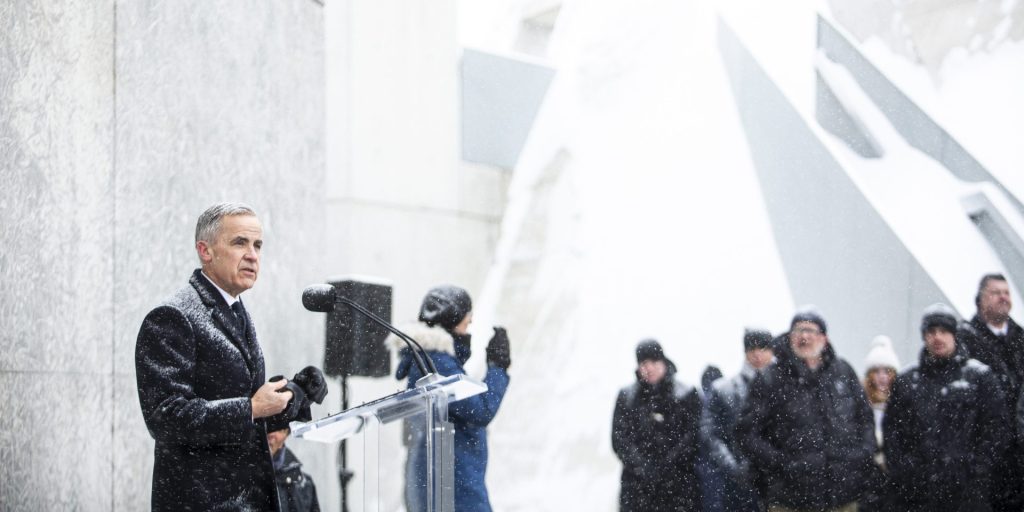
Speaking at Holy Blossom Temple in Toronto on June 1, Carney said combatting antisemitism requires admitting that the country’s “civic compact is failing Jewish Canadians.”
“The crisis of antisemitism in Canada today is specific ... severe, [and] demands a targeted response,” Carney told the synagogue’s congregation.
As part of his speech, Carney also announced the Ministerial Advisory Council on Rights, Equality, and Inclusion, chaired by Canadian Identity and Culture Minister Marc Miller (Ville-Marie–Le Sud-Ouest–Île-des-Sœurs, Que.), with an initial mandate to reassess “the nature, scale, and drivers of antisemitism in Canada,” and develop a whole-of-government response to protect Jewish Canadians.

Joining Miller on the council is former government representative in the Senate Marc Gold, also a constitutional lawyer and former law professor; as well as former Liberal transport minister Omar Alghabra, the first Syrian-born Canadian elected to the House of Commons; Métis rights advocate and publisher Gary LaPlante; retired military officer and LGBTQ+ advocate Martine Roy; Vancouver's former chief equity officer Aftab Erfan; Edmonton human-rights lawyer Avnish Nanda; and Olympian Catriona Le May Doan.
However, that council's reception quickly soured last week as critics combed through its members' resumés.

Speaking with reporters outside the Liberal cabinet meeting on June 2, Conservative Leader Pierre Poilievre (Battle River–Crowfoot, Alta.) said he's "not sure that [Alghabra's] the right guy to combat antisemitism," while a report from The Jerusalem Post highlighted Alghabra's former role with the Canadian Arab Federation and a 2004 letter he penned criticizing Canadian media for describing groups like the Al-Aqsa Martyrs’ Brigade as “terrorists.” The Palestinian group has been a listed terrorist entity in Canada since 2003.
However, in a 2016 House of Commons debate, then-MP Alghabra explicitly referred to the Palestinian group Hamas as a "terrorist organization," and that it would remain designated as such by Canada until it "joins [our] call for peaceful dialogue ... to reach a peaceful resolution to the two-state outcome.”
A June 6 report highlighting the divide among Jewish groups in Canada across the political spectrum also described Nanda as a “lawyer representing pro-Palestinian campus activists,” referring to a Charter challenge filed on behalf of University of Alberta student activists and a Jewish professor over the school's handling of a 2024 campus encampment.
On June 5, the Centre for Israel and Jewish Affairs, B’nai Brith Canada, and numerous national and regional Jewish associations and institutions signed a joint letter to Carney regarding "serious concerns about both the formation and composition" and "alarming questions" about the suitability of individual members due to past positions on "terrorist organizations" and "support for campaigns that have made public institutions and campuses hostile to Jews."
"These positions are diametrically opposed to the principles articulated in your speech,” the letter reads. "This has destroyed the credibility of the [council] and undermined the force of your government’s stated commitment to confront antisemitism."
Outside of last week's cabinet meeting, Miller defended the council as an opportunity for "open and frank" discussions involving people "who have spent a good deal of their career being subject to various forms of hate or have been incredible advocates,” but, by the following day, the criticism had shifted to who was not on the council.

Speaking at a June 3 West Block press conference, former Liberal MP Jean Augustine, the first Black woman elected to the House, said the council's work "cannot and should not be done without the inclusion of a Black and African Canadian."
Police-reported hate crimes targeting Black Canadians have remained above 800 annually in recent years, with 3,859 incidents recorded between 2020 and 2024, as crimes motivated by race and ethnicity accounted for the highest number of police-reported incidents, rising from just over 2,000 in 2022 to 2,377 in 2024.
In response to questions from The Hill Times, Miller's office said the council has a "clear mandate to bring Canadians together and … to combat racism and hate in all their forms," including anti-Black racism, and emphasized that the membership "is not complete."
"As the Council's work evolves to respond to emerging challenges, its membership may also evolve," wrote Hermine Landry, Miller's press secretary. "We won't back down from strengthening our action to combat hatred in our communities and ensure that every Canadian can live in safety, dignity, and respect."
'Advisory means it can be ignored’: Sen. McPhedran
Independent Senator Marilou McPhedran (Manitoba), who contributed to the Senate’s antisemitism report as a committee member, said while she “trusts that the inclusion part” of the council’s membership will be corrected, the exclusion of a Black Canadian in the initial membership is an uncharacteristic and “astonishing gaffe.”
"With his degree of engagement on every ministerial portfolio that I've seen [Miller] in, it's very troubling to see such a superficial approach," McPhedran said. "It's really hard to understand how they thought they could go public without any one of the many Black Canadian experts in this country; it's astonishing."
While McPhedran had some positive things to say about the council, including its focus on “equality over equity” because the former is a "constitutional guarantee," her bigger concern is over the council’s designation as 'advisory'.
McPhedran said advisory bodies can “play a valuable, early role” in shaping new policy or legislation, like the government's anti-hate legislation, Bill C-9, which the Senate returned to the House of Commons after third reading on June 4. But even then, their effectiveness depends on whether governments provide the resources to gather evidence and are prepared to act on the recommendations they receive.

However, after more than 200 recommendations across multiple reports by both the antisemitism and Islamophobia envoys, additional Senate studies on Islamophobia and anti-Black racism and sexism, and a task force report on the Employment Equity Act, McPhedran isn’t convinced another advisory body will produce different results.
“The mandate is advisory—bottom line—and if it's only advisory, it can be ignored,” she said, adding that addressing hate requires institutions with authority to make decisions and a clear action plan to implement them.
“Creating a limited-capacity body … with all of the starting over that's going to be required causes me to question what device this really is," McPhedran said, adding that while she believes those joining the council are acting in "good faith," her concern lies with what she sees as the "largely superficial architecture of the political commitment."
"It's not a very hopeful scenario because there’s a disconnect between the work that's already been done and a federal government that seems to be ignoring the most obvious mechanisms for action," she said.
"It's concerning that we seem to be pouring more dollars and work into more words and reports when we're in the midst of a true epidemic of hate."
Fighting antisemitism needs naming 'elephant in the room' of diaspora conflict: Sen. Housakos
Housakos said that effectively fighting antisemitism will require the prime minister to show the political will to confront what he called the "elephant in the room,"—a message he said Carney came close to delivering explicitly in his June 1 address.
During his speech, Carney said that while Canada “welcome[s] the peoples of the world and their diversity,” it does not welcome “the world’s hatreds.”
"When you come to Canada, you bring your faith, your tradition, your language, your story. You leave behind your wars and your animosities," Carney said, adding that renewing that "covenant … requires that we do not transpose foreign conflicts onto each other."
Housakos argued that the previous the Liberal government's “runaway immigration train over the last decade” had "allowed for various nefarious forces" to operate in Canada, and enabled diaspora communities to import "turmoil onto our shores."

"Geopolitical conflicts that exist in faraway places have all of a sudden come to the streets of [Canada], and the government has tolerated [and] fuelled the crisis," Housakos said, comparing the issue to the findings of the Foreign Interference Inquiry, which identified foreign states using diaspora communities to exert influence and sow division.
"At some point, we also have to acknowledge the problem in this country called the Islamic Brotherhood, and the agents of the Islamic Republic of Iran that we know are operating in Canada."
While Housakos welcomed Carney's comments, he said the message should not be confined to a synagogue audience.
“I want him to say it at every corner of this country,” the senator said, adding that while protests of foreign governments are "fair game," Canadians should never tolerate attempts to intimidate their neighbours.
"Freedom of expression and freedom of religion in this country are something we cherish, but that requires respect for one another as Canadians, and that has completely evaporated."
sbenson@hilltimes.com
The Hill Times