
Cultural groups worry about pressure from U.S. big tech ahead of CUSMA review

The Wire Report subscribers read this story first. Take a free trial to get exclusive coverage of Canada’s telecom and media sectors, and their interaction with the government.
Cultural groups say they are worried America's big tech industry will use its influence to further strong-arm officials into throwing out cultural protections at the negotiating table during the review for North America’s trilateral trade agreement.
This review comes on the heels of the federal government walking back the Canadian Radio-television and Telecommunications Commission's (CRTC) decision to require foreign streamers to contribute to the creation of Canadian content—a decision that shocked the industry. Many saw Canadian Identity Minister Marc Miller’s (Ville-Marie—Le Sud-Ouest—Île-des-Sœurs, Que.) direction to the CRTC to review that decision as the Liberal government bowing to the White House.
Despite for months saying she feels “in good hands” at the negotiation table, Marie-Julie Desrochers, executive director of the Coalition for the Diversity of Cultural Expressions, was less adamant following a recent meeting with the minister.
Desrochers sat down with Miller last week to reiterate her concerns ahead of the Canada-U.S.-Mexico Agreement (CUSMA) review, and get answers about the future of the Online Streaming Act (OSA). But she left the meeting “with a lot of uncertainty.”
“There was no clear answer,” she said. “I think the government is still navigating this. But for us, it was not fully reassuring to say the least.”
“We were told that culture would not be a bargaining chip in the discussions regarding CUSMA and the discussions with the Americans,” Desrochers told The Wire Report. “[But] it appears that it has become one, and we deeply regret that.”
“So what we would really like is to hear from Mr. Miller, as well as from Prime Minister [Mark] Carney, a clear affirmation that culture is not a bargaining chip and will be adequately protected.”
Reynolds Mastin, president of the Canadian Media Producers Association, said Miller’s decision to ask the CRTC to review its OSA decision has “effectively created a separate negotiation involving itself, the domestic industry, and the American streaming giants.”
“And in that context,” he told The Wire Report, “Canada already gives a very good deal to those players.”
Canada has already shown the United States and its streaming giants a willingness to play ball, he said. Now, it’s up to our southern neighbours to knock that ball back.
“All negotiations are about give and take,” Mastin said. “The question is: what are the American streaming giants putting on the table? Because, so far, their position is, ‘we’ll just take all of the benefits. Thanks very much.’”
“Our government, though, has signalled that that isn’t going to be a tenable position.”
The review period for CUSMA is set for July 1, and given the U.S. administration’s volatile track record on trade, the agreement’s future is unclear.
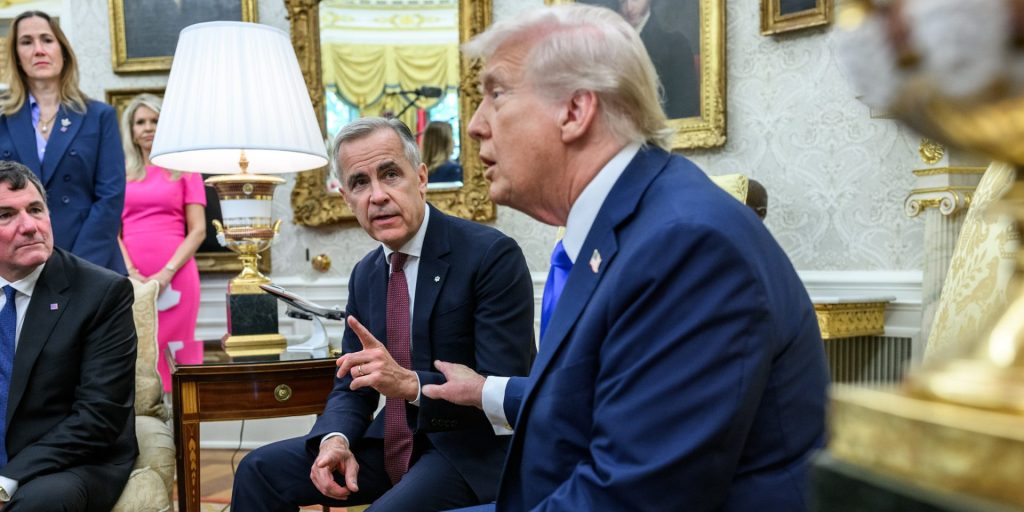
Canada’s Online Streaming Act has already been identified as an irritant for the Americans, and it’s likely other digital policies will be as well.
But Michael Geist, Canada research chair in internet law and e-commerce, says no one should be surprised if U.S. negotiators side with the interests of the country’s tech monopolies.
“Is it possible, even likely, that the U.S. will adopt positions as part of negotiations that are favourable to Big Tech? Sure, in exactly the same way that they adopted those positions that were favoured to the U.S. cultural sector in years past,” he told The Wire Report.
“There’s absolutely nothing new about the U.S. government adopting positions consistent with what some of its larger lobbies [want].”
Geist, also a professor at the University of Ottawa, added the U.S. pressuring Canada to adopt favourable digital policies is akin to when the country lobbied for Canada to implement American-style copyright rules.
Geist said, aside from the OSA, another hard sell will be the regulator proposed by the Safe Social Media Act. The bill, he said, leaves almost all its requirements to be established by regulation, does not identify which companies would be scoped into the proposed ban for users under 16 years old, and the feds are unclear on when the bill will come into force.
“This will be an issue from a trade perspective,” he said.
“When you think through what the government is proposing, and given that the vast majority of the companies are U.S.-based, the U.S. will oppose this.”
In an emailed statement to The Wire Report, Jonathan McHale, vice-president of digital trade for the Computer & Communications Industry Association (CCIA), said his organization supports a full extension of CUSMA without “substantial revisions” to the agreement’s core text.
“That said, the review process does provide a critical opportunity to address outstanding trade irritants, particularly in Canada, which can and should be a subject of negotiation,” the statement read.
The CCIA is an international not-for-profit trade association that represents some of the biggest American tech firms, including Meta Platforms Inc., Alphabet Inc.’s Google, and Amazon.com Inc.
The statement called for the government to repeal the OSA, Quebec’s Bill 109 (which enacts certain French-language requirements for streamers operating within la belle province), and Bill C-18, the Online News Act, “to the extent that they discriminate against U.S. service suppliers and U.S. content.”
“Additionally, Canada should remove the discretion it memorialized in an exception to the agreement (a “non-conforming measure”) that allows it to force U.S. suppliers investing in the audiovisual sector in Canada to purchase specified levels of Canadian content, as a condition of investment approval,” the statement added.
While some folks have raised concerns about the future of CUSMA’s cultural exemption, Geist said he expects Canada will fight to keep it, even if it’s merely symbolic.
“One of the ways the government signals that it cares about and defends Canadian culture is through the cultural exemption,” he said. “It has a signalling value to, especially cultural groups ... it’s viewed as a strong defence of Canadian culture by saying that the government will defend it in its trade deals.”
Geist suggested the exemption is less effective than sometimes perceived, and argued it’s not so much an exemption but rather an ability to violate the trade agreement on the condition of facing significant tariff penalties.
Whether the White House, acting in the interest of big tech, will be able to pressure Canada into dropping any of its policies remains to be seen. But it’s a big concern for Desrochers.
Carney (Nepean, Ont.) already scrapped the Digital Services Tax after pressure from U.S. President Donald Trump, and now, following the OSA decision, Mastin thinks demands from U.S. companies have gone too far.
“They’re taking Canada for granted,” he said. “We’re a sovereign country that enacts certain policies to create space for Canadian storytelling.”
“All countries have rules, and ours need to be respected.”
Maria Collins is a reporter at The Wire Report where this piece was first published. The Wire Report covers the intersection of business, technology, and government, with a special focus on the regulatory sphere. Sign up here for a free trial.
The Hill Times